

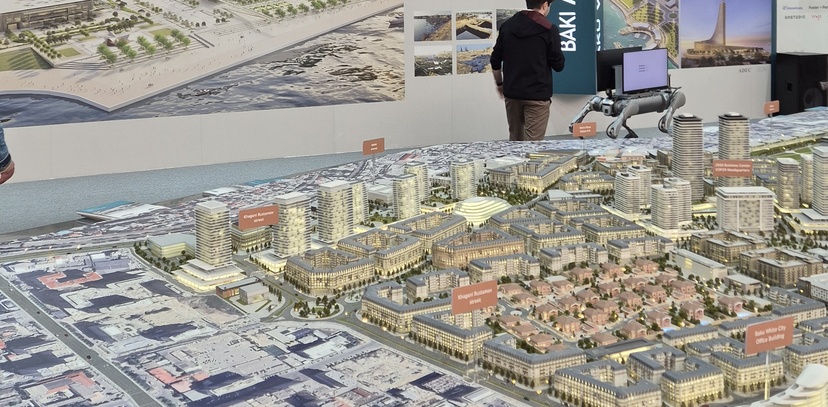
In May 2026, the 13th session of the World Urban Forum (WUF13), organized by UN-Habitat, is taking place in Baku, Azerbaijan. The forum is a critical space for uniting global stakeholders to address pressing challenges of rapid urbanisation and the climate crisis. This year is particularly significant as it marks the 10th anniversary of the New Urban Agenda - the forum is a strategic midpoint in its 20-year cycle to review progress and urgently accelerate its implementation.
Social Life's Dr Simeon Shtebunaev is in Baku, here he reflects on housing as a foundation of human dignity and social cohesion and how our work points to ways to move housing beyond the provision of physical structures driven by market imperatives.
Focused on the theme "Housing the World: Safe and Resilient Cities and Communities," WUF13 aims to position housing not merely as a numerical issue, but as a foundational stone of human dignity and social cohesion. WUF13 aims to forge integrated urban solutions that combine housing, climate resilience and local financing to ensure inclusive and sustainable cities for all.
The global housing crisis: what is the plan?
The focus of WUF13 is tackling the global housing crisis in all its manifestations. At Social Life we think that to ensure housing strategies which genuinely promote social inclusion, we must move beyond the financialised delivery of physical housing units to designing with and for the social world. Our Design for Social Sustainability framework was developed over 10 years ago for the agency responsive for housing delivery in the UK at the time - the Homes and Communities Agency. Design for Social Sustainability - or DfSS - offers a tried and tested framework for situating housing in the heart of place, ensuring we build communities as well as homes.
Throughout post-occupancy evaluations across housing estates in the UK - including on the South Acton Estate and Woodberry Down) our research reveals that designing with the DfSS principles in mind is only the first step. To bridge divides, encourage participation and social cohesion and improve quality of life, developers and local authorities must invest in equitable management and maintenance as place-keeping as much as place-making and place-shaping. Long-term stewardship, accessible social infrastructure and inclusive programming can prevent residents living parallel lives and foster belonging.
Our ongoing work on a Decent Neighbourhood Standard (with the Centre for New Midlands and Witton Lodge), has pushed us to think about the need for minimum standards of quality, accountability and community participation, which enshrine human dignity and respect not only in the designed output but also in the social practices and professional processes shaping places.
What we hear
Regardless of whether homes are being built in a new build scheme, an estate regeneration or a community-led development, residents consistently voice the same core priorities for housing across our research.
People want safety and security in their homes and in their area. Improving community safety, providing accessible and inclusive public realm and preventing anti-social behaviour is a universal priority across all our work. Yet, we often see a lack of creativity in the design of social and physical realms which can support this goal.
Genuinely affordable housing. Residents consistently demand homes priced according to local incomes, not market rates. Across the regeneration projects we work in such as Woodberry Down and South Acton, residents fear that they or their children will be priced out of their own neighbourhoods as private owners move in.
Better retrofit, repairs and maintenance of existing homes. In ongoing regeneration areas like the Aylesbury Estate, Grahame Park, and Cambridge Road Estate we encountered cases of deteriorating conditions, persistent leaks and broken heating in older blocks which impact daily life and the mental health of residents. Retrofitting properties and exploring alternatives to outright demolish and rebuild housing models can help tackle some of those issues.
Inclusive social infrastructure and spaces for children and youth. Communities we work with consistently want affordable, neutral spaces to mix, such as community cafes, independent shops and specific facilities for young people and teenagers, who often lack safe, unstructured places to hang out. This was strongly highlighted in our work on the Beehive Shopping Centre, and our social impact assessments at South Acton and Clapham Park.
Respect, develop and foster community ties within neighbourhoods. Residents often want to stay together and deeply value their neighbours, wanting to be rehoused together or remain on their estates to preserve their support networks. This desire to avoid displacement and maintain the social glue of the area is voiced across all of our work.
Messages for policy
Key policy messages emerge consistently across our research, demonstrating how housing must be planned to support the WUF13 goals of safe, resilient, and inclusive communities:
Physical proximity of different tenures does not in itself guarantee social integration but is crucial. Creating a "tenure-blind" neighbourhood is only the first step; mixing social renters with private owners does not automatically mean they will mix socially. In post-occupancy evaluations at Woodberry Down and Clapham Park we see that people can live parallel lives unless developments invest in deliberate and shared inclusive programming and open-access community spaces that actively bridge social divides. Rehousing residents should take into account their preferences and needs.
Regeneration and construction disruption impact mental health and community resilience. The uncertainty of housing delivery models and prolonged regeneration, the threat of displacement and living on active construction sites causes profound psychological distress. We saw this most prominently at the Aylesbury Estate, where residents left behind in deteriorating older blocks during phased developments reported high levels of anxiety, poor wellbeing and a sense of being neglected by authorities.
Early provision of social infrastructure is vital for new communities. Providing facilities like schools, transport links and community spaces early in the development process, coupled with staff presence on site and a programme of community activities, helps new residents bond, develop a local identity, and build resilience. This was a key finding in establishing strong communities at Kidbrooke Village and Beaufort Park.
Informal networks are a primary safety net. Strong local social relationships and a moral gift economy (exchanging favours, looking out for neighbours) are critical for survival in deprived areas. Regeneration and large-scale housing projects must avoid destroying these established networks, as seen in the highly interconnected and supportive but vulnerable communities we spoke to at Cambridge Road Estate.
Communities must have genuine voice and influence embedded in delivery and governance structures. Across most of our social impact assessments the "Voice and Influence" dimension consistently scores the lowest. To build sustainable communities, residents need genuine power over their environment, rather than sporadic top-down consultations and engagement without a long-term vision. Situating the participatory process in their immediate context can enable intergenerational participation. Better governance, methods and tools to empower residents could be achieved through models like Community Land Trusts, co-designing health interventions with residents as we did in our project on Southwark Estates or employing residents as paid researchers – as we did at Clapham Park. This builds trust and ensures developments serve local needs.
How can this be done – responding to the WUF13 Call to Action on Housing
The WUF13 Background Paper frames Dialogue 5 around the premise of housing as an engine for inclusive economic development, social cohesion, and resilience, stressing that the socio-economic returns extending far beyond its direct economic output. In responding to the questions posed by Dialogues 5 of the World Urban Forum, we think that:
We believe there is space for community-owned and mutual housing models, as they inherently capture land value and keep financial and social benefits within the local area.
Beyond direct funding, governments can strengthen housing resilience by planning for the long-term stewardship, social infrastructure and adaptability of a neighbourhood, embedding long time horizons in their visions and frameworks.
