


Social infrastructure is often seen in isolation, discussed as a series of discreet projects funded by specific pots. In practice these are powered by local activism and social relationships - the reality of what supports communities is often messier and more dynamic than some policy discussions suggest. The social infrastructure/s that underpin changing community relationships and needs are inevitably not permanent and contained, compared to a school or a shop. When new communities are formed, because new homes are built or buildings repurposed, community supports will develop out of a cocktail of social relationships and social networks, buildings and fixed places, and temporary and fluid uses.
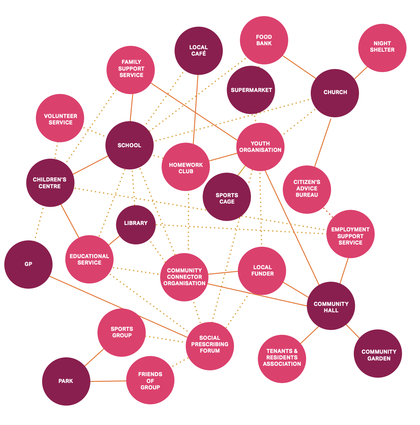
We see social infrastructure as an eco-system of support, a web that brings together all the different things that help people get by, socialise, network and access support and services. Sometimes this sits within formal buildings like libraries or GP surgeries, but it also brings together community noticeboards in cafes, well-sited benches, the support and mentoring offered by barbers, the neighbourhood whatsapp group, the dogwalking routes and the skatepark that young people hang out in. Social infrastructure ecosystems are by definition based on relationships, and are unqiue to each place or community. We drew on this idea heavily in our work for the Mayor of London published as Connective Social Infrastructure.
Awareness of the importance social infrastructure in regeneration and new housing is not new. It goes back to the work of Le Corbusier and his vertical garden city, the post war British new towns and earlier utopian communities. It is important to create the facilities and services that we all need - schools and community centres and dentists - but do we create create the nuanced, place specific and organically grown provision that turns social infrastructure provision into a flourishing eco-system?
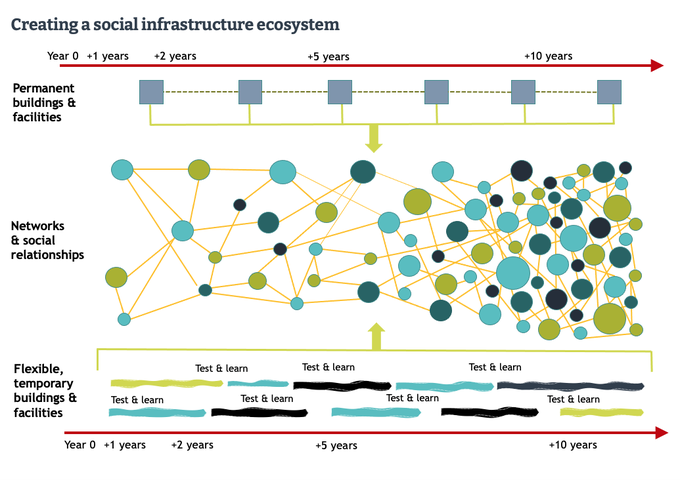
Creating the structures and buildings that communities need has to be mirrored by support for social relationships and for temporary, flexible buildings and facilities - these are useful in the short-term and prototype future more permanent provision. There is a dynamic relationship between all these factors, with social relationships and social networks sitting at the centre, acting as the glue that holds emerging communities together.
We see examples of how this can work in many places at small scale, from the resident-organised Coopers Edge Trust in Gloucestershire, building community in the early stages of a new development, to new community-rooted spaces in London regeneration schemes, working with sociologists in Hamburg's Hafen City and Civic Square's involvement in the Port Loop development in Birmingham.
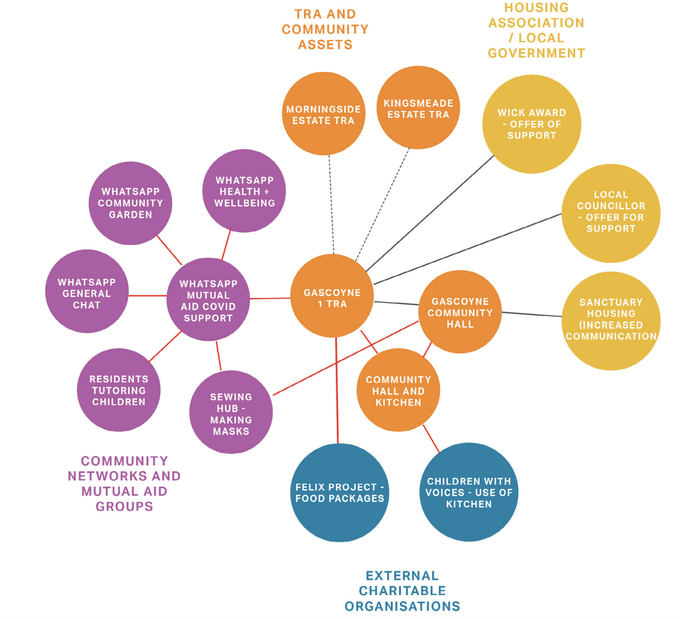
We saw how social infrastructure eco-systems supported our communities during the pandemic, flexing to support rapidly changing needs and an unprecedented crisis. On the Gasgoyne Estate in Homerton we saw how old and new supports and providers worked together during COVID - our map of community relationships during the pandemic is below. We need to find ways to help new communities grow these systems of support, to support everyone's wellbeing and resilience, to help their residents flex and get by in the face of potential economic precarity and the climate emergency.